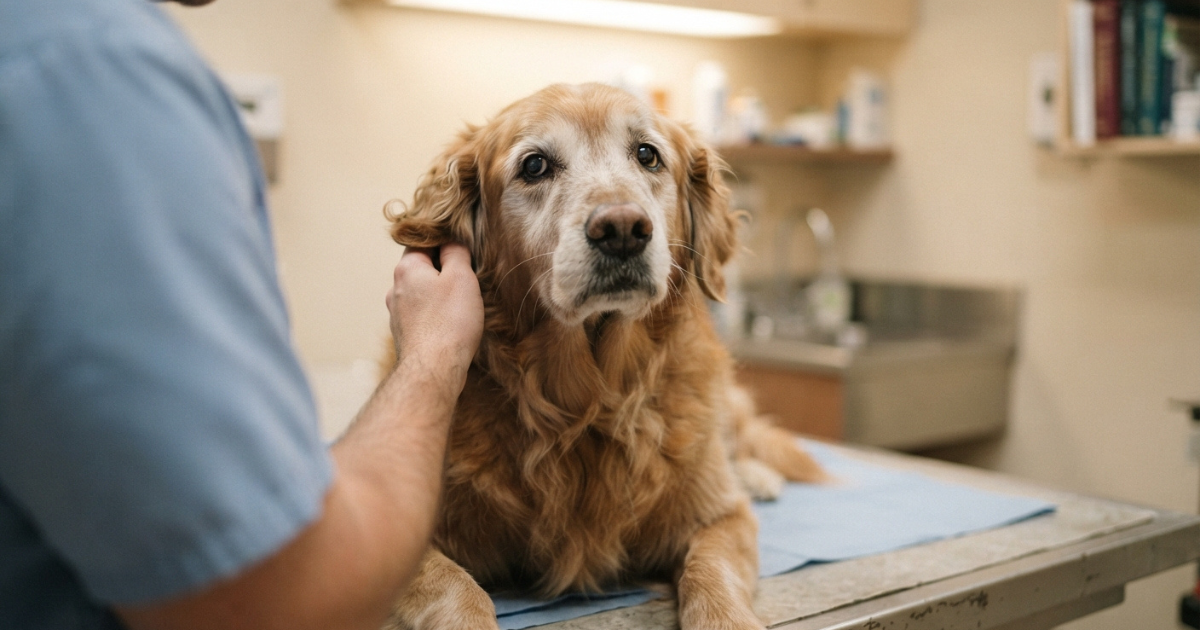
Your old dog stops in the middle of the living room and just stands there, staring at nothing. Or he’s up pacing at 2 a.m., barking at a wall like something’s wrong, even though nothing’s there. If you’ve started wondering whether your dog is “losing it” with age, you’re picking up on something real — and it’s a lot more common than most owners realize.
This isn’t something you caused, and it isn’t an emergency. But understanding what’s happening — and catching it early — genuinely changes how comfortable your dog’s senior years can be.
Table of Contents
What Dog Dementia Actually Is
Vets call it cognitive dysfunction syndrome, and the comparison to Alzheimer’s in people holds up better than most pet-health analogies do. It’s caused by a buildup of a protein called beta-amyloid, which forms plaques in the brain and interferes with how neurons pass signals to each other. Combine that with the reduced blood flow that comes naturally with age, and you get a brain that just doesn’t process the world the way it used to — memory gets shaky, spatial awareness slips, learned behaviors stop sticking.
It develops slowly, almost never overnight. And it’s more common than people expect: research puts it at around 28% of dogs aged 11–12, climbing to roughly 68% of dogs 15–16 years old. If your dog lives into his late teens, cognitive decline becomes more likely than not.
Signs to Watch For
The symptoms tend to show up in a recognizable cluster, though rarely all at once:
- Wandering the house with no clear destination, especially once it gets dark
- Getting physically stuck — wedged in a corner, unable to figure out how to turn around
- Barking or howling at seemingly nothing
- Standing near the food or water bowl like he’s forgotten it’s there
- A noticeable rise in anxiety, panting, or general unease
- House-soiling in a dog who’s been reliably trained for years
- Pulling away from the family, or the opposite — becoming clingy or distressed when left alone
- Forgetting cues and tricks that used to be automatic
- Sleep flipped upside down — sleeping hard all afternoon, restless all night
One or two of these could be nothing. A cluster of them, especially if it’s worsening over weeks or months, is worth a real conversation with your vet.
“Barking that seems to come from nowhere isn’t always dementia, though — if barking on its own is your main concern rather than a broader pattern of confusion or disorientation, our guide to the 8 causes of nighttime barking walks through the full range of possibilities.”
What Causes It
The short version: it’s aging-related brain deterioration, driven largely by that beta-amyloid buildup and the way it disrupts neuron function. But the longer, more useful version is that a lot of other conditions in senior dogs cause nearly identical symptoms, which is exactly why vets don’t diagnose dementia based on behavior alone.
Liver disease can cause ammonia buildup that leads to genuine confusion. Kidney disease, UTIs, and bladder stones can all cause house accidents with nothing to do with the brain. Arthritis can make a dog pace and seem anxious simply because lying down hurts. Ruling these out first isn’t just procedure — it matters because several of them are treatable in ways dementia isn’t.

How Vets Diagnose It
There’s no single test that confirms cognitive dysfunction. It’s built through elimination: a physical exam, bloodwork, often X-rays to screen for the conditions above, and — in rarer cases where something more specific is suspected — a CT scan to check for tumors or structural issues.
What actually moves the needle most in that appointment is you. Before you go in, it helps to sit down and think through a few things: Has he seemed disoriented? Have his interactions with the household changed? Is his sleep cycle different? Is he having accidents? Has his anxiety or activity level shifted? Has his learning or memory changed?
If you’re answering yes to more than one, say so directly. Your vet may walk you through a CADES worksheet — a Canine Dementia Scale that measures how far the changes have progressed — which gives you both something more concrete to work from than “he’s just been acting different.”
Managing It
There’s no cure, and catching it early is what actually makes the difference. Treatment usually blends a few things: a tight daily routine, since a confused brain leans hard on predictability; small environmental tweaks like a nightlight or a smaller, simpler space to reduce how often he gets stuck or starts vocalizing; and, with your vet’s input, supplements or a prescription diet — omega-3s, SAM-e, and antioxidant-rich formulas have the most consistent research behind them.
Selegiline is the one FDA-approved medication for this, and according to AAHA’s senior care guidelines, it can genuinely help with sleep, house-soiling, and general alertness — though it doesn’t mix with several common drugs, so that’s a decision your vet needs to make with you, not one to try solo.
Keep loose notes on appetite, sleep, and mood every few weeks — the changes are too gradual to catch day to day, but a month-to-month comparison tells you a lot. And when accidents happen, try to leave the frustration out of it. He’s not ignoring his training; that part of his brain just isn’t working the way it used to.
Making Daily Life Easier
A handful of small changes tend to do more than anything expensive or complicated:
- Keep food and water bowls in exactly the same spot, always
- Add a nightlight if he struggles more after dark
- Put non-slip mats down near where he sleeps or walks most
- Don’t rearrange furniture, even for a deep clean — spatial memory is one of the first things to slip
- Keep greetings and interactions calm rather than big and excited
- Sit with him through anxious moments instead of leaving him to work through it alone
- Hold off on major changes — a new pet, a move, extended boarding — if you can help it right now
When Not to Wait
Any behavior change in an older dog is worth mentioning at your next checkup, but a few things call for getting in sooner: confusion that comes on suddenly rather than gradually, new house-soiling in a dog who’s never had accidents, a sharp jump in anxiety, or any shift that happens over days instead of weeks or months.
Fast, sudden changes are actually less likely to be dementia and more likely to be something else — pain, infection, a neurological event — that needs quicker attention. Don’t assume the worst-case explanation is the right one; let your vet rule things out properly.
Judging Quality of Life
As things progress, it’s worth periodically stepping back and asking honestly how your dog is actually doing, rather than just reacting to symptoms one at a time. Is he eating and drinking normally? Moving around comfortably? Getting real, restful sleep? Still perking up for the things that used to make him happy — a certain walk, a favorite person, a particular toy?
There’s no universal checklist here. What matters is the trend over weeks and months, and having that conversation with your vet regularly rather than once and done. Plenty of dogs stay comfortable and genuinely content well into cognitive decline when there’s the right support around them.
The Bottom Line
If your senior dog has started getting stuck in corners, pacing at night, or seeming a little lost in his own home, trust that enough to bring it up with your vet — sooner rather than at the next routine visit. A lot of what looks like dementia turns out to be something else, and even when it isn’t, there’s real support available: environment, diet, supplements, medication, and just a bit more patience day to day.
Dogs who spent years being patient with us deserve the same back.
FAQ
Can dog dementia be cured?
No — cognitive dysfunction syndrome is progressive and currently has no cure. Treatment focuses on slowing the decline and keeping your dog comfortable through routine, environmental changes, diet, and sometimes medication.
At what age do dogs typically start showing signs of dementia?
Symptoms can start appearing around age 10–11, though they’re often subtle at first. Prevalence rises sharply with age — studies show roughly 28% of dogs aged 11–12 are affected, climbing to about 68% of dogs aged 15–16.
Is dog dementia painful?
Dementia itself isn’t physically painful, but it can cause real anxiety, confusion, and distress. That said, pain from other conditions like arthritis often overlaps with dementia symptoms, which is exactly why a full vet workup matters before assuming it’s cognitive decline.
Can diet or supplements actually help a dog with dementia?
Some can. Omega-3s, SAM-e, and prescription diets rich in antioxidants and medium-chain triglycerides have shown benefit in studies, though results vary by dog. They work best as part of a broader plan discussed with your vet, not as a standalone fix.