By Relax My Paws Team | Updated: September 2026 | 8 min read
Disclosure: This post may contain affiliate links. If you purchase through them, Relax My Paws may earn a commission at no extra cost to you.
Quick take: Nina Ottosson Dog Puzzle (made by Outward Hound) is one of the most established names in dog puzzle toys, split into four clear difficulty levels. They’re genuinely good for mental enrichment and slowing down fast eaters — just don’t expect them to fix real anxiety on their own, and know that determined chewers and some small breeds can struggle with the plastic pieces.
Overview
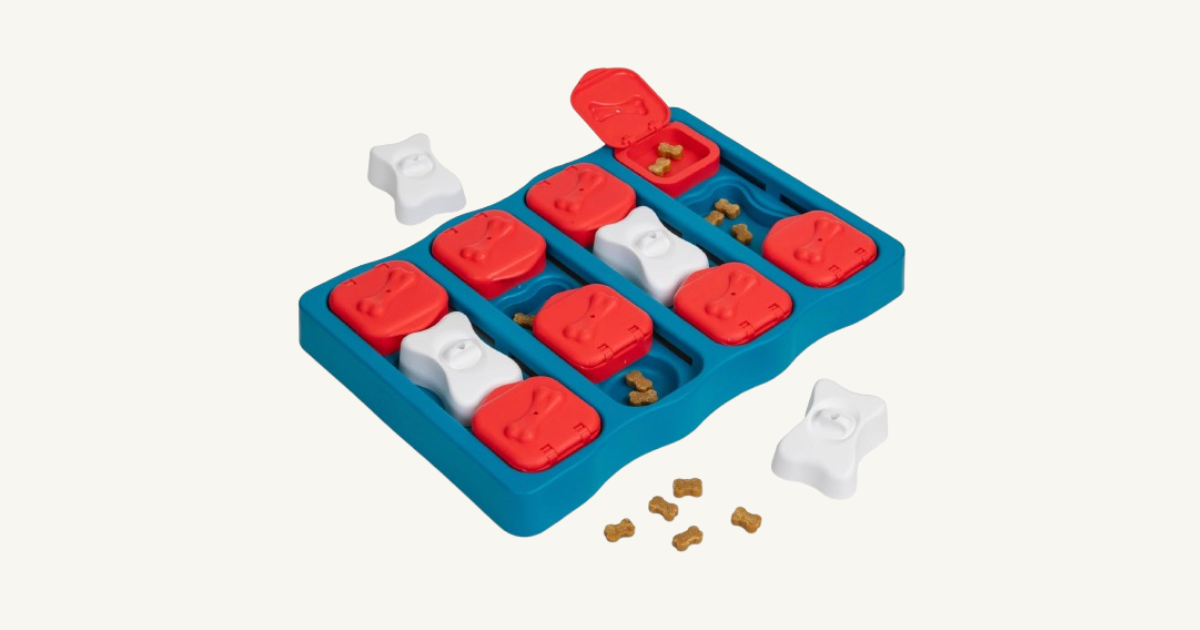
If you’ve ever watched a dog inhale an entire bowl of food in under a minute and then stare at you like “okay, what now?” — that’s basically the gap Nina Ottosson puzzles were built to fill. Nina Ottosson herself is a Swedish toy designer, and her name is now attached to Outward Hound’s whole line of interactive treat puzzles: toys that make a dog slide a lid, spin a disc, or flip a tab before they get their reward.
The logic isn’t complicated. Dogs need mental work the same way they need a walk, and a bowl on the floor doesn’t ask anything of them. A puzzle does.
Nina Ottosson dog puzzle
Level 2 Interactive Puzzle Feeder, 20 Hidden Compartments for Mental Enrichment
$15
The Level System
The line is split into four difficulty tiers, which makes it easy to start where your dog actually is instead of guessing:
- Level 1 (Beginner) — simple mechanics: pegs to pull, a ball to roll. Good for a dog who’s never seen a puzzle before. Treat Tumble, Dog Smart, Puppy Smart, Lick N’ Flip.
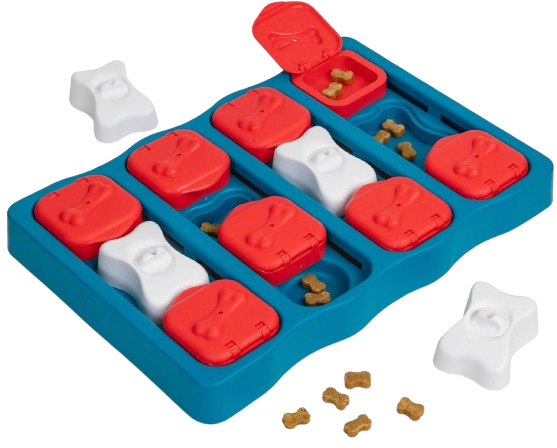
- Level 2 (Intermediate) — sliding lids or flip lids that take a bit more figuring out. Hide N’ Slide, Dog Brick.
- Level 3 (Advanced) — needs a sequence of steps, not one single action, to get the treat out. Dog Worker.
- Level 4 (Expert) — stacks several mechanisms into one puzzle, for dogs who’ve outgrown everything else. MultiPuzzle.
One tip that’s easy to skip: start at Level 1 even if your dog seems sharp. A dog that gets frustrated early tends to lose interest in trying the next puzzle altogether — better a fast, easy win than a discouraging first try.
Size and Breed Fit
This part doesn’t get talked about enough. Puzzle difficulty isn’t the only variable — physical fit matters too. Owner reviews on the Dog Brick, for example, note that the sliding tiles and lift tabs can sit close enough together that small breeds struggle to get a paw or nose underneath to open them, and a couple of reviewers mention worrying about nails catching on the smaller tabs. If you’ve got a small or short-muzzled dog, it’s worth checking a specific product’s size notes before buying, and watching the first session closely to see if they can actually operate the mechanism — not just whether they want to.
Large, strong-pawed dogs have the opposite issue: some can muscle a lid open with brute force rather than actually solving it, which defeats the point a bit. If that’s your dog, the sequence-based Level 3–4 puzzles hold up better than the simple sliding-lid ones.
What They Cost
One thing in this line’s favor: it’s genuinely accessible. Simple Level 1 toys like the Treat Tumble usually run under $10, and the more elaborate puzzles top out around $15–$20. For structured mental enrichment, that’s a low bar to clear.
How Nina Ottosson Compares
| Nina Ottosson (by level) | Kong Wobbler | PetSafe Busy Buddy | |
|---|---|---|---|
| Mechanism | Sliding lids, flips, multi-step sequences | Wobbles and dispenses kibble randomly | Twist-apart chew with treat compartment |
| Difficulty range | 4 clear levels, beginner to expert | Single difficulty, mostly passive | Varies by model, generally low-moderate |
| Best for | Dogs who like problem-solving, slow feeding | Fast eaters, low-supervision feeding | Chewers who also forage |
| Price range | ~$8–$20 | ~$10–$18 | ~$8–$15 |
| Durability | Moderate — not built for hard chewers | Fairly durable, made for knocking around | Nylon body holds up to chewing |
None of these is objectively “best” — a Kong Wobbler is closer to a slow feeder than a brain game, while Nina Ottosson’s higher levels ask more of a dog mentally. If your dog is a chewer first and a thinker second, Busy Buddy or a Kong product will probably outlast a Nina Ottosson puzzle.
Nina Ottosson dog puzzle
Level 2 Interactive Puzzle Feeder, 20 Hidden Compartments for Mental Enrichment
$15
Does This Actually Help With Anxiety?
Worth being precise here. You’ll see the line “15 minutes of mental stimulation equals 30 minutes of physical exercise” repeated across a lot of pet product listings, this brand’s included — treat that as marketing shorthand, not a cited finding. There’s no specific study behind that exact ratio.
What does hold up: foraging and problem-solving give a dog something constructive to do, which can genuinely help with boredom-driven behavior and take the edge off predictable stressful moments — like the ten minutes before you leave for work. That’s a real, useful piece of a bigger plan, and it’s covered in more depth in our guides on building a daily routine for anxious dogs and managing separation anxiety — both treat puzzle feeders as one tool among several, not the whole plan. A puzzle toy on its own won’t do much for a dog with genuinely severe anxiety.
Pros
- Clear difficulty ladder, so you’re never just guessing what’s appropriate
- Genuinely affordable next to most enrichment products
- Taps into a dog’s natural foraging instinct instead of a flat bowl
- Doubles as a slow feeder for fast eaters
- Enough variety in mechanisms to stay interesting as your dog levels up
Cons
- Plastic construction on many models isn’t built for aggressive chewers — some owners report dogs eventually prying or chewing through pieces
- Needs supervision early on, so a dog doesn’t damage the toy or swallow a small part
- Small breeds can struggle with tight tabs on some Level 2 models
- Not a fix for real anxiety by itself — a supporting tool, not a treatment
- Some dogs need a demo before they get the mechanism, especially Level 2 and up
Choosing the Right One
New to puzzle toys, any age: Start at Level 1 — Dog Smart or Puppy Smart are solid entry points, and both double as slow-feeders at regular mealtimes.
Breezed through Level 1: Move to Level 2 (Hide N’ Slide or Dog Brick) rather than jumping straight to the hardest option.
Small or short-muzzled dog: Check the specific product’s tab size before buying, and watch the first session to confirm they can physically work the mechanism.
Food-motivated, puzzle-savvy dog: Level 3 or 4 (Dog Worker, MultiPuzzle) will hold their attention far longer than the easier levels.
Known chewer: Supervise closely no matter the level, and don’t treat any of these as an unsupervised all-day chew toy.
Safety Notes
Watch the first several uses of any new puzzle so you know how your dog actually interacts with it — some solve it the intended way, others just try to chew through to the reward. Determined chewers and dogs with strong nails (especially on the Dog Brick’s tighter tabs) should stay supervised rather than left alone with it, and retire any puzzle the moment pieces start to crack or come loose.
FAQ
What age can a puppy start using puzzle toys? Most Level 1 puzzles — including ones labeled specifically for puppies — are fine once a puppy is on solid food and can be supervised. Check the specific product’s age guidance to be sure.
Can these replace a food bowl entirely? Some owners run a Level 1 puzzle as a full-time slow feeder. If your dog seems to lose interest or gets frustrated trying to eat an entire meal from it every time, rotate with a normal bowl instead.
My dog solved it in 30 seconds — now what? That’s your sign to move up a level, not stick with something that’s stopped being a challenge.
Is this safe for a small dog? Depends on the model. Some Level 2 puzzles have tabs tight enough that small breeds struggle to grip them — check size notes and supervise the first try before leaving your dog alone with it.
Are these safe for aggressive chewers? Not unsupervised. Determined chewers can get through plastic puzzle pieces faster than the average dog, so don’t leave one out as an unattended chew toy.
Sources: Outward Hound — Guide to Dog & Puppy Enrichment Toys, Wear Wag Repeat — Nina Ottosson Hide N’Slide Review, Floppycats — Dog Brick Puzzle Toy Product Review,